
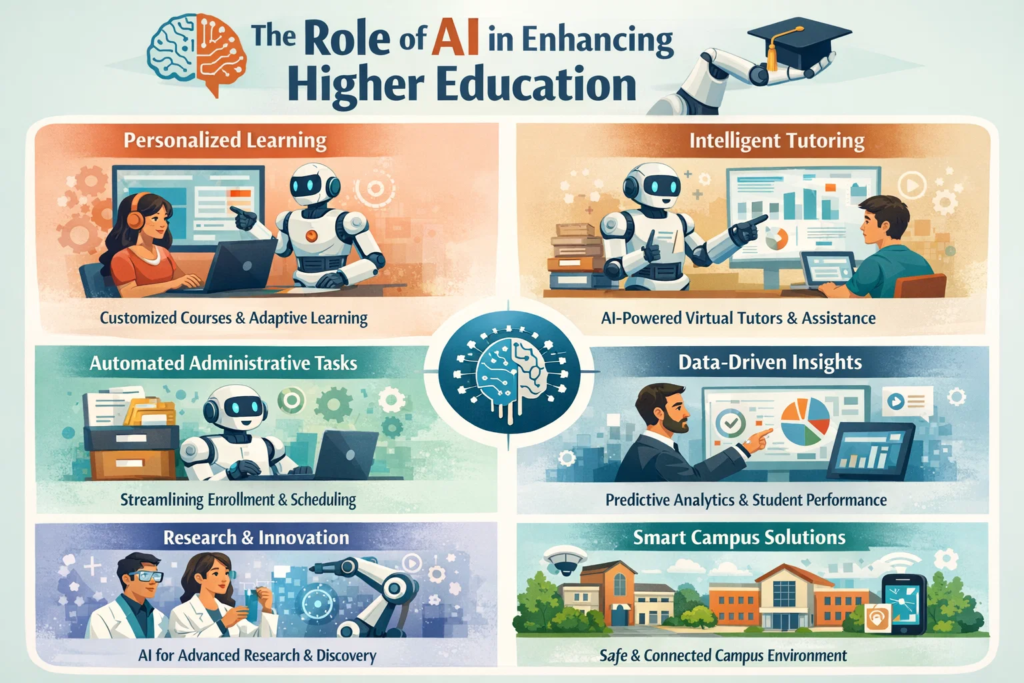

Artificial intelligence has been evolving as a significant concept in today’s world, mainly when it comes to transforming the higher education system. Universities in UK and around the world are integrating AI-based technologies to enhance their teaching quality. These tools keep students engaged in lectures, offer academic support and lead to an efficient administrative system.
As the digital revolution accelerates, Artificial Intelligence is becoming one of the most crucial concepts, they need AI at every step of their education. AI is leading to crucial changes in reshaping higher education.
What is AI in Higher Education?
AI in the higher education system refers to the tools and technologies that simulate human intellect to perform academic tasks. Imagine having an assistant that monitors academic progress, provides personalised resources for studies and gives instant suggestions. Not only this, but it also predicts areas where users require improvement. It is exactly what AI provide to students and teachers.
From data analysis to performance tracking and automated feedback to personalised learning. Everything is available within seconds, using AI-powered tools. Usage of these tools is transforming the learning and teaching process by accelerating research and offering 24/7 student help. It basically acts as a key tool that enhances students’ efficiency.
Contribution of AI in Transforming Higher Education
Every student possesses their own strengths and weaknesses that require personalised feedback, which is now possible with the help of AI. It makes education personal. Students have access to a wide range of adaptive platforms that monitor their performance. Moreover, after detailed analysis, they suggest valuable study resources based on their needs.
It helps in developing a fruitful learning experience, which caters to diverse student needs. Below are a few points that show how AI is making education highly efficient for both learners and teachers.
AI-Tools for Academic Supports
AI provides instant academic assistance to students. From a Harvard referencing generator to a grammar checker, it offers a range of effective tools. Students can use them to speed up their ordinary and regular academic tasks. In addition, they can generate essay format, summarize articles and make notes. These tools allow students to speed up their work and focus on their studies.
Enhancing Data Analysis and Research
Research is one of the most time-consuming yet mandatory processes for every student. It can be overwhelming for students. Thus, AI tools enable them to assess large datasets and spot identical patterns. It helps scholars in visualising results within seconds. Whether they are working on case studies or surveys, AI eliminates long manual work. It provides quick insights, enabling them to work on analysis and critical thinking. As a result, they can produce excellent research.
Supporting Online Learning
AI creates an engaging and interactive online learning experience. It tracks the participation of students and suggests useful content by analysing their activity. Also, it gives virtual training when required. Whether students need to attend classes remotely or submit projects virtually, AI ensures they stay connected and on track. These advanced tools make online education more responsive, effective and personalised for students, regardless of their location.
Key Challenges of Increasing Use of AI
The increasing and rapid evolution of AI in the higher education system presents notable challenges, leading to ethical dilemmas, including:
1. Data Privacy
AI systems placed in institutes rely on student information, including personal details and scholarly records. The storage of this data raises key concerns of data breaches. However, universities can avoid this threat by ensuring strong cybersecurity features and adhering to data protection policies. It prevents unofficial access and maintains privacy.
2. Dependence on Automation
Students are in such a hurry these days. Hence, they rely completely on AI tools for their homework. It reduces their ability to think creatively and solve problems. Students use automation systems for every work, whether it is writing or research. It weakens their critical academic proficiencies.
3. Fairness Issues
AI systems use datasets for predicting the performance of an individual, which leads to biased results. Thus, these tools require constant monitoring, as these unfair results can affect the complete grading mechanism. It results in unfair decisions and uneven treatment for students.
4. Limited Human Interactions
Learning is not only about collecting knowledge but also about discussion and mentorship. Increased use of automation tools may limit such valuable communication between teachers and students. Human guidance is crucial for emotional support and personal development of learners. That AI cannot simulate through its advanced tools.
5. Academic Integrity Concerns
The availability of advanced AI writing tools helps students in generating projects quickly. For instance, if a student needs plagiarism checker uk, they can use AI to generate the complete work. It creates key concerns about originality, plagiarism and realistic learning.
Expert Tips to Use AI with Integrity
AI tools enhance the higher education system, but it is vital to use them responsibly to avoid digital threats and maintain integrity. Hence, here are a few smart ways of using AI to balance your work with academic standards:
1. Use AI as an Assistant
While using AI, students must know that it is only for assistance and not for copying whole content. Hence, it is crucial to use AI for brainstorming ideas, structuring outlines and clarifying key concepts. For instance, scholars can use platforms like assignment help uk to ensure they meet their academic standards before submission. Students must ensure they use AI as a helping hand rather than a tool that gives general answers.
2. Edit the Content
AI tools often lead to biased, outdated and wrong data. Thus, it is crucial to check the content once before using it directly. After analysing all details, they must edit the content based on their personal understanding. It prevents the submission of wrong content and ensures integrity as well as academic quality.
3. Follow University Guidelines
Many colleges provide precise guidelines outlining the rules of using AI in projects. Students should familiarise themselves with these policies before using AI in their coursework. Also, if needed, students should acknowledge the use of AI to maintain transparency. Following these guidelines ensures adherence to academic standards.
4. Protect Personal Data
It is the most crucial factor that students must consider when using AI. They should avoid uploading personal or research data online. In addition, they should choose a reliable and secure platform which provides strong privacy.
Final Thoughts
In a nutshell, AI play a significant role in enhancing the contemporary higher education system. Whether it is about offering a personalised study plan or monitoring the performance of an individual, AI does it all. Integration of AI in education marks a prominent shift towards student-centred education.
However, the successful implementation of AI in education depends largely on responsible usage and ethical application. For this, students can rely on Using it ethically will help to refine and strengthen the traditional way of teaching.